Weather · the kit
The weather station
What's on the pole in the garden, where the readings go, and how you can use them—or your own nearest station—for nothing.
The station
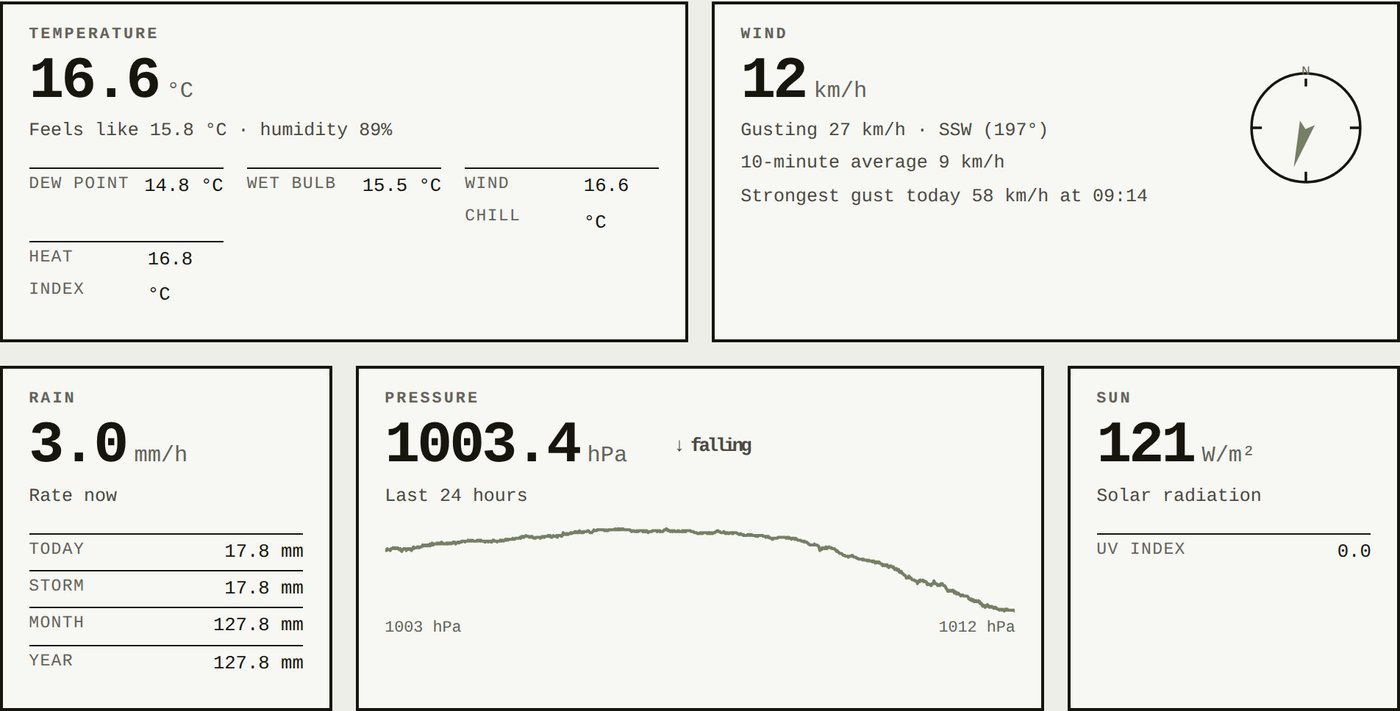
Out in the garden there's a Davis Vantage Pro2 on a pole. It's the sort of weather station you see on farms and at schools, and in the gardens of people who check the rain gauge before they check their phone. We're those people.
It's really one unit. There's a rain collector on top, a thermometer and humidity sensor tucked inside a white slatted shield so the sun doesn't cook them, and a set of spinning cups on an arm for the wind. It runs off its own little solar panel and sends everything by radio to a screen in the house every couple of seconds. It sits out through every Connemara winter without complaint, which is more than can be said for us.
Sun and UV
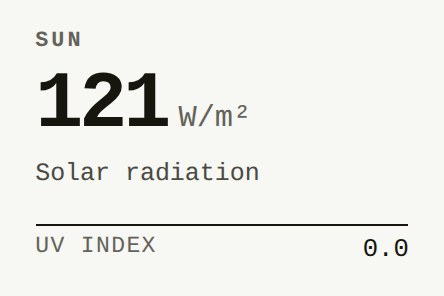
Ours is the Plus version, which adds two small sensors next to the rain collector. One measures how much sunshine is actually getting through, in watts per square metre—on a clear June day it'll go past 800, and on a day like the one above it barely bothers. The other reads the UV index, the part of sunlight that burns. Between them they give a truer picture of a day than "sunny spells" ever does, and the sunshine figure lets the station work out how fast the garden is drying out. We don't often need telling.
WeatherLink
Indoors, a Davis WeatherLink console picks up the radio signal and sends the readings up to WeatherLink, Davis's own website, once a minute. That's where this site gets its numbers—every figure on the weather page comes back down from there.
The useful bit for you is that WeatherLink isn't just ours. Thousands of Davis stations report to it, and there's a map of them. Make a free account, open the map, and you can see what's happening at every Davis station that shares its data: the ones dotted round Connemara, the rest of Ireland, and right across Europe. It's a good way to find out what the weather is actually doing near you, rather than at an airport eighty kilometres away.
Ours is on there under the name Cloughbrack. You do need the account to see it—there's no way round that—but it costs nothing.
Weather Underground
We also send our readings to Weather Underground, which is where the station becomes part of something bigger. It's a network of over 250,000 home weather stations around the world, each one run by someone with a gadget in the garden and an interest in whether it's about to rain. Nobody is paid to do it. The company hosting it is a commercial one, but the network itself is just people sharing what their bit of sky is doing. Citizen science, in other words, with more rain gauges.
You don't need an account to look. Our station is listed as Cloughbrack, but the quickest way to find it is to search for its ID, ICLOON9. From its page you can open the map and click on any station near you. They all feed into one central database, so you can compare the valley with the hill, or see whether that shower is heading your way.
One thing to know: Weather Underground started out in America and shows Fahrenheit by default. To switch to Celsius, click the cog in the top left corner and change the units. It's worth doing before you decide it's 58 degrees and go looking for your shorts.